Castle · Swiss Riviera, Lake Geneva Region
Château de Chillon
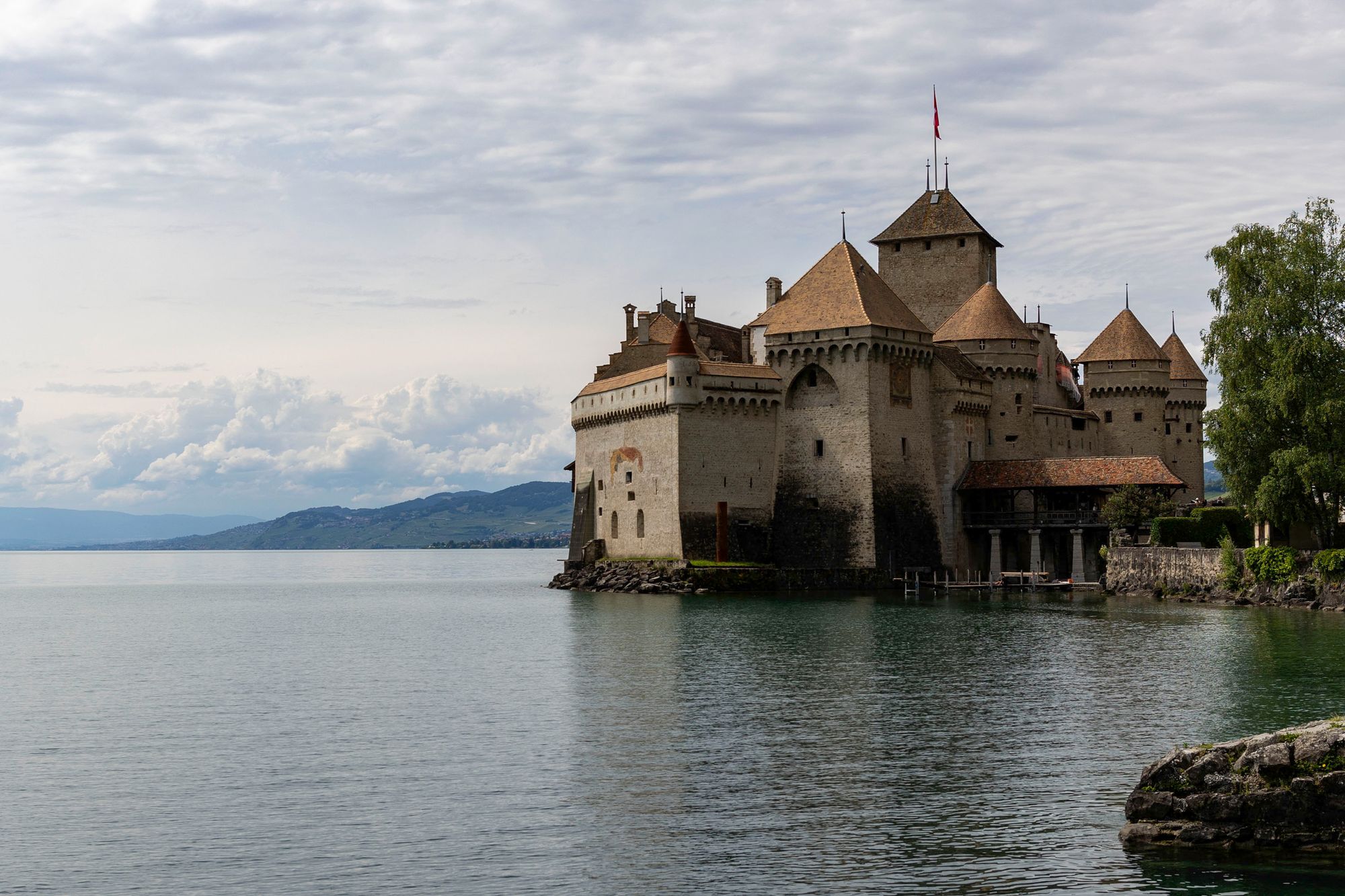
A medieval castle on a rock in Lake Geneva, made famous by a Byron poem.
Photo: Philippe Forestier / Pexels
- Canton
- Vaud
- Language
- French
- Time to allow
- One and a half to two hours inside. Half a day including the walk from Montreux and a coffee on the shore.
- Best time
- Open year-round
Built on a small limestone island a few meters off the shore at Veytaux, just south of Montreux, Chillon guarded the narrow road between the lake and the mountains for centuries. The Counts of Savoy turned an earlier fortress into a residence and toll post in the thirteenth century, and the castle has survived largely intact, which is rare. Reached by a short wooden bridge, it looks almost as if it is floating.
Inside, you walk through a sequence of courtyards, vaulted halls, bedrooms, latrines and towers — more than twenty spaces in all. The most visited is the dungeon carved into the rock, where the Genevan monk François Bonivard was chained for several years in the 1530s. Lord Byron visited in 1816, wrote The Prisoner of Chillon about him, and carved his own name on a pillar. That poem turned the castle into a stop on the Romantic tour of Europe, and it has drawn visitors ever since.
What to do
Château de Chillon, at its best
The underground vaults
Gothic rib-vaulted chambers cut into the rock at lake level, with light coming through narrow windows from the water. Look for Byron's signature scratched into the third pillar of Bonivard's prison.
The great halls and the chapel
The Duke's hall, the aula nova and the camera domini (the Count's bedroom) keep painted walls and timber ceilings. The chapel has faded medieval murals.
The keep
Climb the narrow stairs of the central tower for a view straight down onto the lake, the Montreux shoreline and across to the Dents du Midi.
The view from the shore
The classic photograph is taken from the lakeside path a few hundred meters south of the castle, looking back at it with the mountains behind. Walk there after your visit.
Getting there
How to reach Château de Chillon
From Montreux
Walk along the lakeside promenade, flat and about 45 minutes; or take trolleybus 201 from the town center, around 10 minutes. In summer, lake steamers stop at the castle's own pier.
From Geneva
Train to Montreux in a little over an hour, then the bus. Some regional trains stop at Veytaux-Chillon station, a few minutes' walk from the entrance.
From Lausanne
Regional train to Montreux or Veytaux-Chillon in about 25 minutes. A slower, scenic alternative is the CGN boat from Ouchy.
From Interlaken
Take the GoldenPass line to Montreux (just over three hours) and continue by bus; realistically this is a stop on a transfer day rather than a return day trip.
From our specialists
Before you go
- 1Buy tickets online in high season to skip the ticket queue; entry itself can still slow down when groups arrive.
- 2Inside, routes are signposted with numbered rooms and the free brochure or audio guide explains each one. The stairs are narrow and uneven — not suited to pushchairs.
- 3Combine the castle with the Montreux promenade and lunch in the town, or come by boat from Lausanne and leave by bus — a good half day of variety.
Book a day out
Tours and tickets for Château de Chillon
Guided tours, mountain tickets and day trips run by local operators, with prices and reviews from our booking partner Viator. Book one on its own, or ask us to fit it into your holiday.

Chillon Castle Entrance Ticket in Montreux
from CHF 14.5

Montreux, Chaplin's World and Chillon Castle Day Trip from Geneva
from CHF 161

Swiss Riviera Day Trip from Geneva: Montreux, Chillon and Chaplin's World
from CHF 161

Montreux Walking Tour: 60 Minutes with a Local Host
from CHF 79
Book it
Holidays that reach Château de Chillon
 Switzerland only
Zurich · Lucerne · Geneva
Swiss Essentials
5 nights 3 stops
 Switzerland only
Geneva · Zermatt · Zurich
Swiss Lakes & Peaks
5 nights 3 stops
 Switzerland only
Geneva · Interlaken · Zurich
Alpine Highlights
5 nights 3 stops
 + Austria
Geneva · Innsbruck · Salzburg · Vienna
Best of Switzerland & Austria
9 nights 4 stops
 + Italy
Milan · Zermatt · Interlaken · Lucerne · Geneva
Swiss-Alpine Italian Escape
10 nights 5 stops
 Switzerland only
Zurich · Interlaken · Lucerne · Geneva
Swiss Explorer
9 nights 4 stops
Questions
Asked about Château de Chillon
Is Chillon included in the Swiss Travel Pass?
The Swiss Travel Pass includes the Swiss Museum Pass, and Chillon has been part of that scheme, giving free entry. Confirm before your trip as participating sites change.
Can you visit Chillon in winter?
Yes. The castle opens all year apart from a couple of public holidays, with shorter hours in winter. The lake steamers do not call in the cold months, so use the bus.
Is it worth it if I am not interested in history?
The setting alone justifies the walk along the shore. Inside, the state of preservation is remarkable for a building of this age, and many visitors who expect to stay half an hour end up staying two.
Combine it with