The short answer
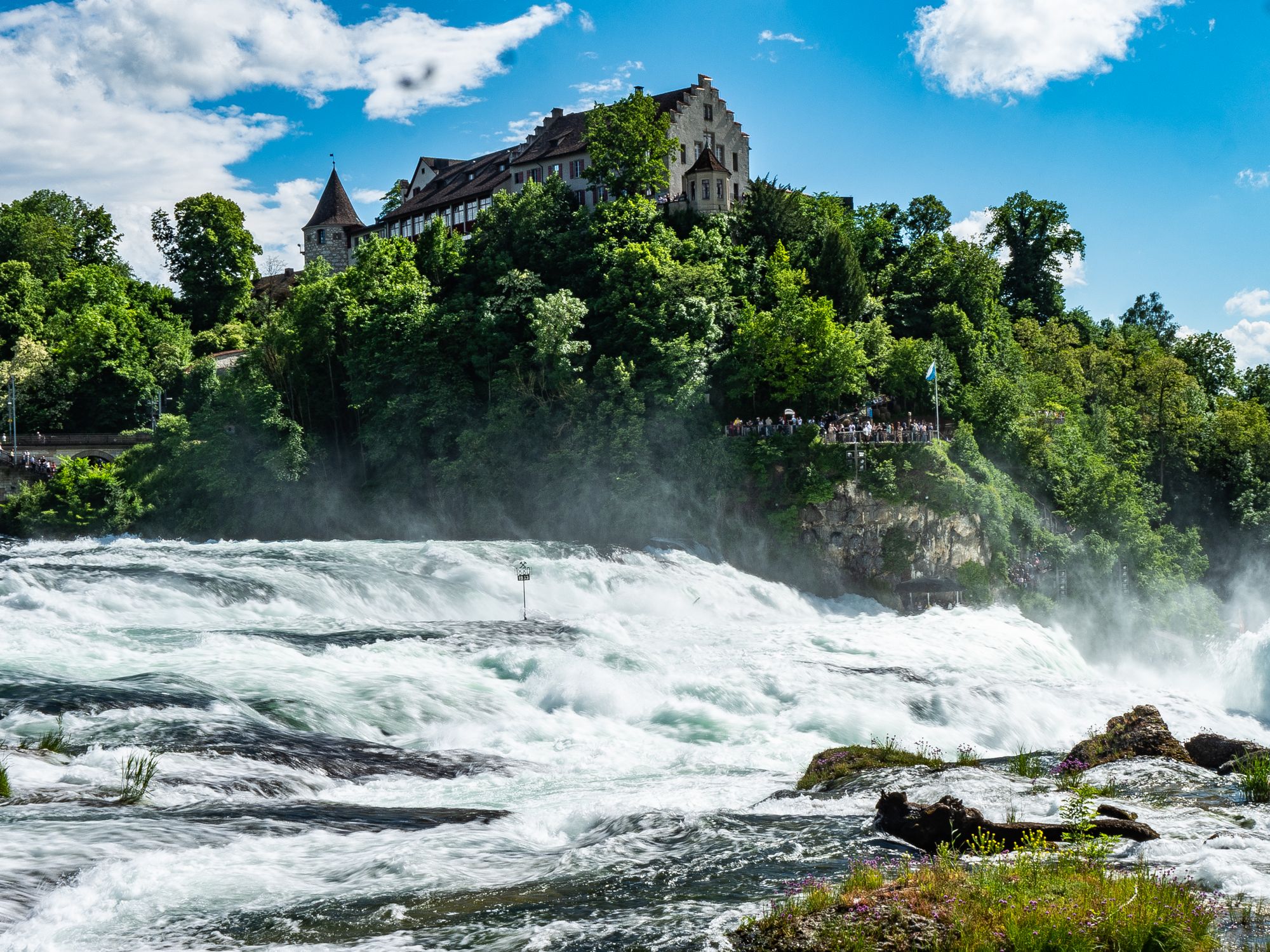
The main boat at the falls leaves from below Schlössli Wörth and lands passengers at a tall rock in the middle of the cataract, where stairs climb to a small platform with water passing on either side. If you would rather stay on the water, shorter round trips on the river below the falls go across to the far bank without landing. Boats generally run from spring to autumn, so most visitors combine a boat with the castle platforms and a walk, then add Schaffhausen on a day from Zurich.
The Rhine Falls sit just downstream of Schaffhausen, a short train ride from Zurich, and they are a favorite excursion from the city. The falls are not especially tall, so the experience depends on how close you get to the water. This guide compares the boat options, the platforms you can reach without a boat, and how the falls fit alongside Schaffhausen.
Being near the water is what makes the falls memorable. Spray can reach you on the lower platforms and the noise often makes conversation difficult, which is why a boat trip is worth considering if you want to be close to the cataract rather than looking at it from the banks.
Compare
Your options at a glance
| Option | How it works | Time | Best for |
|---|---|---|---|
| Boat to the central rock | Small boats leave from below Schlössli Wörth and land passengers at the foot of a tall rock in the middle of the falls. Stairs climb to a small platform at the top, with water running past on both sides. | Part of a two to three hour visit, in season | Visitors who want to stand among the falls and are comfortable on wet, steep steps. |
| Basin round trips | Shorter sailings on the river below the cataract, going across between the north and south banks without a landing. | A short trip, fitted around the platforms and a walk | Anyone who wants to be on the water without climbing the rock. |
| Schloss Laufen platforms (no boat) | Walkways reached from the castle courtyard on the south bank by stairs or a lift. The lowest platform sits almost at water level beside the main cataract. A modest entry charge applies. | Usually the core of a two to three hour visit | The closest you can get to the falls on foot. |
| Walk around the falls | A footpath on the railway bridge above the falls links the two banks, giving a circuit that takes in the castle platforms, the north-bank promenade and views from above. | About an hour for the full circuit | Seeing the falls from above and comparing the two banks. |
Rock boat or basin round trip?
The rock boat gives the most immersive experience, but it asks more of you. The boats land passengers at the base of the central rock, and from there stairs climb to the summit, where you stand with water rushing past on both sides. Good footwear matters, because the rock steps are wet and the top platform is small.
If the stairs do not suit you, the basin trips are a sensible alternative. They stay on the water, pass close to the spray and let you see the scale of the falls from below, without a landing or a climb. For many visitors, one round trip and a stroll along the platforms covers what they came to see.
- Rock boat: landing, stairs, wet footing, seasonal.
- Basin round trip: no landing or climb, suits a shorter visit.
The platforms and the walk round
The south bank offers the most direct ground-level access. The walkways at Schloss Laufen are reached from the castle courtyard by stairs or a lift, and the lowest platform sits almost at water level beside the main cataract. An entry charge applies, and the Swiss Travel Pass does not cover it.
The north bank is the more relaxed side, with the boat landings, a broad promenade and cafés. A footpath on the railway bridge connects the two banks, so you can complete a circuit in roughly an hour, seeing the castle side from one bank and the falls from above.
- Schloss Laufen: stairs or lift, lowest platform near the water.
- North bank: boat landings, promenade and cafés.
- Railway bridge footpath: roughly an hour for the full circuit.
Timing and the season
June and July are the strongest months, when snowmelt from the Alps brings the river to its fullest. The rock boats generally run from spring to autumn, so early summer is when high water and boat sailings coincide.
In winter the falls flow lower but remain impressive, and you will share them with far fewer people. The viewpoints and the walk are available through the colder months, but the rock boats do not run then, so a boat trip needs the warmer part of the year. Check the current timetable before you travel, as season dates can shift.
- Early summer: highest flow, boats running.
- Autumn: boats still running, but check the last sailing.
- Winter: quieter, platforms open, no rock boat.
Adding Schaffhausen to the day
Schaffhausen is only a few minutes from the falls by local train, and it is well worth the extra time. Its old town is known for painted façades and many surviving oriel windows. Above the vineyards sits the Munot, a 16th-century round fortress with a spiral ramp built wide enough for horses. Each evening at nine, the Munot watchman rings a small bell, a quiet tradition that is worth timing a stroll around.
Visiting the falls in the morning and Schaffhausen in the afternoon suits most travelers. The boats get busy from late morning, so an early start helps at the falls, and the old town is pleasant later in the day. It is small enough to see in two or three hours.
If you want more time on the river, boats run from the Schaffhausen landing stage towards Stein am Rhein in season, roughly from spring to mid-autumn. The upstream journey takes considerably longer than the return, so many people take the train to Stein and the boat back.
- Morning: falls, boat and platforms.
- Afternoon: Schaffhausen old town and the Munot.
- Optional: boat towards Stein am Rhein.
Planning a day from Zurich
Zurich is the usual base. Trains to Schaffhausen take about 40 minutes, and a local train covers the few minutes to Neuhausen Rheinfall for the north bank. Some regional trains from Zurich via Winterthur stop at Schloss Laufen am Rheinfall, right by the castle, in around an hour. From Lucerne, allow about 1 hour 45 minutes to the falls, and from Basel about 1 hour 15 minutes to Schaffhausen.
The Swiss Travel Pass covers the rail and bus journey, while the boats and the castle platforms are paid separately. Allow a full day from Zurich rather than squeezing everything into a few hours.
Guided options exist if you would rather not plan the connections yourself. Half-day tours from Zurich cover the falls, and one also includes Stein am Rhein. They are listed on this page with their own details.
Tips from our specialists
- 1Go early: the boats get busy from late morning, so reaching the falls first gives you a calmer visit.
- 2Dress for spray rather than rain. Sleeves and camera straps can get soaked on the platforms, so a light waterproof layer and a cloth for your lens help.
- 3Choose footwear with grip, since the lower platforms and the rock steps are wet.
- 4Budget for the extras: the Swiss Travel Pass covers rail and bus travel but not the boats or the Schloss Laufen platforms.
- 5Check the timetable for season dates before you go, especially if the rock boat is the reason for your visit.
Book it
Tours and tickets
Run by local operators, with prices and reviews from our booking partner Viator.

Rhine Falls and Stein am Rhein from Zurich: A Guided Half-Day Trip
from CHF 74.8

Rhine Falls by Minibus with a Scenic Route from Zurich
from CHF 49

Private Rhine Falls Half-Day Tour from Zurich with Hotel Pickup
from CHF 178.5

Zurich Walking Tour with Lake Cruise and Hilltop Cable Car
from CHF 88

Zurich Walking Tour, Lake Cruise and Felsenegg Cable Car Day Trip
from CHF 87

Rhine Falls and Schaffhausen Small-Group Day Trip from Zurich
from CHF 165
Questions
Frequently asked
How long do I need at the Rhine Falls?
Allow two to three hours for the platforms, a boat and a walk round. With Schaffhausen added, it becomes a relaxed half-day from Zurich.
Can I take the boat to the rock in winter?
Generally not. The rock boats run in the warmer months, while the viewpoints and the walk are open through winter, when the falls are quieter.
Is there a boat option if I do not want to climb steps?
Yes. The basin round trips stay on the water and cross to the other bank without a landing, so there are no rock stairs to climb.
Is the Rhine Falls the biggest waterfall in Europe?
It is not the tallest, but it is usually described as the largest plain waterfall in Europe by volume of water, which is the measure that matters most here.
Can I go from Schaffhausen to Stein am Rhein by boat?
Yes, in season, roughly from spring to mid-autumn. The upstream trip takes longer than the return, so check the timetable before choosing your direction.